

 I found photo journaling after years of traditional diaries and journals stopped working. As an adolescent, I found great comfort in writing daily notes and thoughts in a diary and that practice supported me into adulthood as I transitioned to journaling. I have several volumes of journals, but I rarely go back to them. In the last few years, I found myself less motivated to journal. I couldn’t fully put my finger on it until I actually found something different and better. My journals ended up either being lists of events or the same patterned complaints and negative thoughts. I got tired of writing my negative thoughts and found the practice didn’t even give me the relief it once did. Without conscious intention, I stopped journaling altogether.
When we reach midlife, we may find we are disconnected from ourselves because we have had to put ourselves behind those we care for or serve. There is nothing wrong with this. Our loved ones benefit, and we can take great pride in that care. It’s just that over time we get so good at hiding our true feelings and squashing our emotions and needs that we lose touch with who we are outside of that service. Life can begin to feel like a daily repeat, and journaling can feel the same; the same patterns of thought reflected back to us. I think at this stage we want more than recognition  of patterns. Awareness alone isn’t enough anymore. We want to know what to do with it. We want to move forward.
The good news is that, if you are already a journaler, a simple shift to photo journaling will help you find your way toward the best next steps for you. When you read a journal prompt and begin with photo selection, the surface level story comes to mind first. But as you search and think more deeply about how you want to represent that story, you might struggle to settle on an image because you begin to realize that there is actually much more to what you want to say and how you feel. Struggling with this initially isn’t bad, it is a sign that you are waking up a bit more inside.
When you try a new process, your brain pays more attention and w orks in different ways, naturally shifting that old pattern of prompt then journal, and new things pop up naturally. After you work through photo journaling using this practice consistently, you will find you can lean into your intuition and select photos more quickly. You learn to trust your gut reaction and to communicate your thoughts through visual representation much more quickly.
The insights that unfold are priceless. I remember working through my own dissertation methodology and when I selected photos that represented my burnout experience, I settled on one with my son. The image was of him on stage reading his fifth grade graduation essay while I stood slightly behind him as the principal of the school. The image captures the tension I felt in my desire to just be his mom and celebrate him, but I was also the face of my school on stage. Seeing the image brought about raw emotions and when I journaled, so much of that mom guilt and the imbalance between work and life came through.
When I do decide on a photo, it carries way more meaning than words on a page in my journal. I don’t have to process a thought, consider how to word it on the page, or wonder what order to write in. The image holds all the meaning, context, and often things hard to put into words. By the time I sit down to start writing, words often seem to fly across the page. I don’t have to worry so much about starting and stopping in my thoughts as things come up. Because the flow feels smoother, it almost feels as if something unlocks inside of me and my subconscious opens to reveal hidden meaning I might not have unveiled if I just started with journaling. It really is hard to explain until you sit with the method yourself. I don’t always fully understand how it works, but it does and I trust the 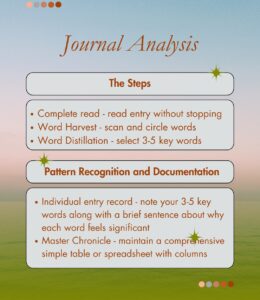 process.
Word harvesting came from my research practice where I read and reread participant transcripts to find themes and deeper meaning within their own stories. I selected words that came up over and over again, or words that felt like they carried a lot of weight. They might not seem significant at first, but when highlighted and held next to a few other words they really validated or strengthened other ideas. It made me wonder — how could we turn this practice toward ourselves to help us unpack deeper meaning using a journaling practice we already use?
There is no wrong way to harvest words from your journal. The practice puts you totally in charge of making meaning. But if you go into reviewing your writing with a preconceived notion of what you will find, things might get missed. That is why it is important to read through once without stopping, and then go back and select words based on your gut feeling or intuition. You get to decide what feels significant. Once selected, you review all the words and pare them down. Why? Because having to make a decision forces you to really lean into what is most meaningful, true, or significant. It is like dress shopping. You find three you love and you can’t really decide which one is best until your friend picks one for you and suddenly you know it isn’t the right one — it is one of the others.
Would you like to change up your journaling routine? Or maybe journaling was never quite your thing, but photo journaling sounds like something worth trying. Click the “Get Started” button on the homepage to download a free guide that includes three photo journaling starter prompts so you can explore this method for yourself. If you do, please come back and leave a comment below. I would love to hear what surfaces for you!

0 Comments