
“It crept up on me, this slow deadening of my feelings. At first it felt like maturity. I wouldn’t tear up any more at movies, emotional stories, happy family milestones… I wouldn’t cry when I felt sad. I was in control! Wasn’t that evidence of maturity – as sort of the ability to desensitize oneself from one’s surroundings in order to get to the logical solution, behavior, “appropriate” action?”

The bad haircut. That’s how it all started. You know how it goes…off to the hairstylist with a photo in hand (or on your phone) of a lovely or handsome individual who has the hairstyle you dream of. It looks great on them and you think it would be great for you. The stylist does their level best to create such a style even though your hair might be a different texture, color…insert other attribute. There is always that moment then, when they swivel the chair around to the mirror for you to see and….
This happened to my daughter as a young teenager. She had her long hair cut in a bob style and it didn’t work out. I had a similar experience at a similar age. I could have gone to her room and told her all about my story and how I understood what she was feeling. It’s what we do as humans much of the time – connect with shared experiences. But, something in me refrained. I was on my own healing journey by then and I just knew she needed to feel. I knew no matter what I said, I couldn’t make her feel better. We sat in silence for a time – silent tears rolling down her face. At some point, she decided she was done feeling sad or ready to move on and we worked through a process that ended up as the FACTOR method I will share below. It always begins with FEEL.

Witnessing my daughter’s raw emotions in that moment held up a mirror to my own relationship with feelings. I had spent so many years learning to suppress rather than express them.
As young women (men, too), we are taught to push away our emotions. To reject them without thought in favor of control and peace. Whose peace? I’m here to tell you, it isn’t ours. The effects? There are so many books and articles about the effects of unexpressed emotions on our mental and physical health and my research uncovered a few within the individual stories of burnout in midlife women teachers. I heard stories of tingling feet, panic attacks, elevated/racing heartbeat, pain in specific places in the body. I will share my own experience and examples from my research in later posts.
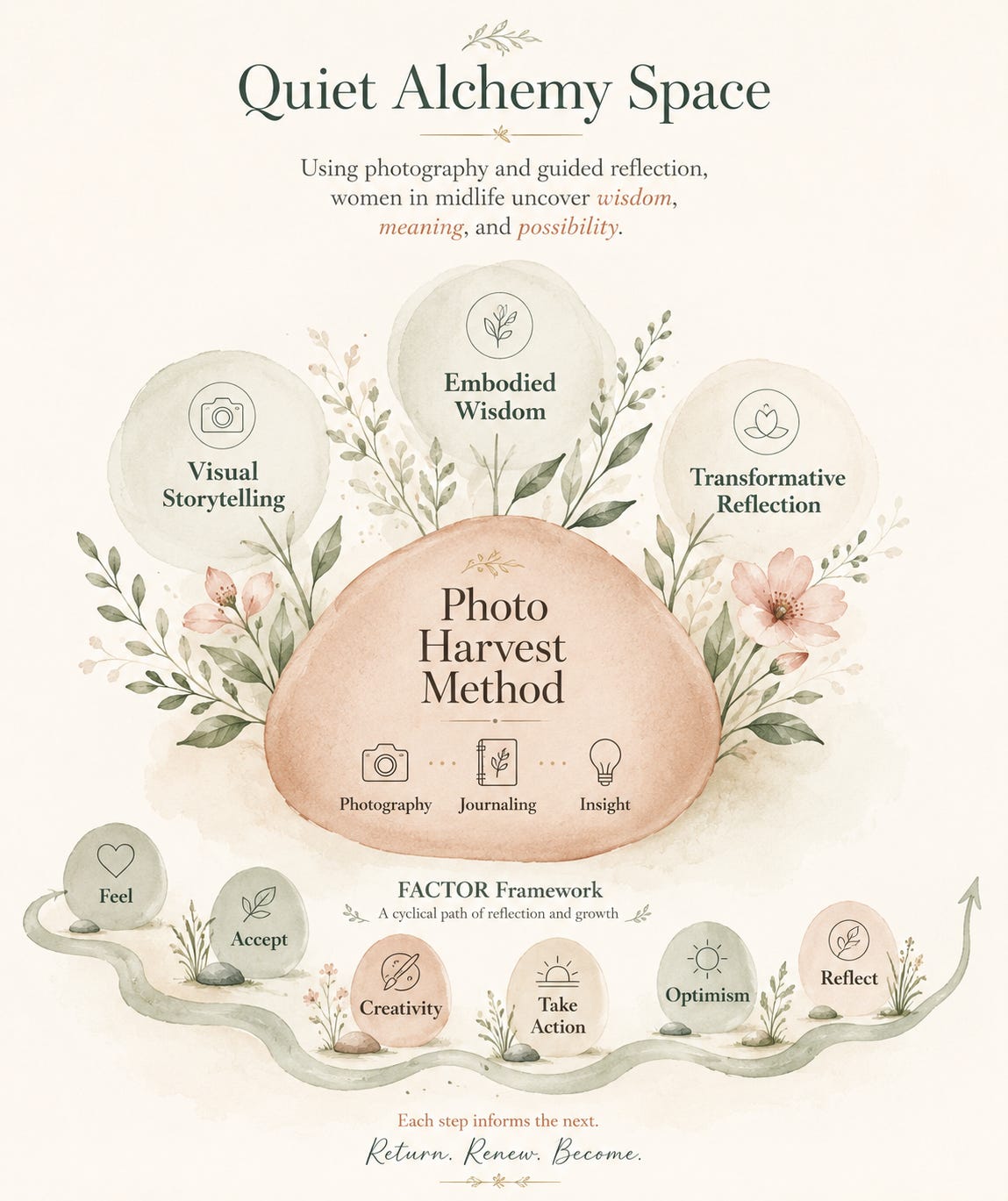
In this first post, I’ll share the beginning of the FACTOR model—focusing on Feeling, Acceptance, and the transformative power of Creativity and Community. These initial elements form the foundation for healing, creating space for the remaining components that I’ll explore in part two.
Let’s begin with what is often the hardest first step:
F — FEEL
It crept up on me, this slow deadening of my feelings. At first it felt like maturity. I wouldn’t tear up any more at movies, emotional stories, happy family milestones. I wouldn’t cry when I felt sad. I was in control! Wasn’t that evidence of maturity? The ability to desensitize oneself from one’s surroundings in order to get to the logical solution, behavior, “appropriate” action? I became so good at control that I almost lost the ability to feel and, when I did feel emotions, the sense that I was out of control was so strong that it left me feeling shame, remorse, and like a failure. I had buttoned myself up so much that to feel anything besides happiness was to be “less than.” It makes me sad to think about this now, and I want to go back to my 30 or 40-something self and tell her, “It’s okay, let those feelings out. It’s okay to feel sad, angry, anything. It means you are human, and having feelings means you are whole. If you don’t, your body will hold them in ways you won’t want.”
A — ACCEPTANCE
Accepting and acknowledging yourself, what is in your control, and what isn’t.
Acceptance for me came from being shocked and terrified of my own behavior. Late one night, I decided to stay up after my family went to bed and have a relaxing drink — to let the feelings out. It was toward the end of “the bad year” when I lost several family members, was in a car crash, and started feeling the full effects of burnout in my job. I could feel the need to let emotions out, and this was the only way that I could get myself to release them, to loosen the control. I’m not a drinker, so this was a big move. And because I don’t drink, I didn’t recognize the signs when it was enough until my body reacted naturally and saved me from alcohol poisoning. I was embarrassed and put affected items in the laundry right away to hide my shameful experience.
That night became my turning point. In the morning, I saw myself clearly for the first time in months — someone desperately trying to maintain control while everything was falling apart. Not falling apart around me, but within me. There are many of us who appear to have it all and hold it all together. We push through each day, convincing ourselves that countless other priorities deserve our attention more than taking time to actually feel our emotions. Somehow, we’ve learned to treat our own feelings as optional — something to address only after everything else is handled. I realized that my attempts to appear strong for everyone else, and to push through without acknowledging my limits, had led me to this breaking point.
Acceptance wasn’t immediate. It began as a whisper of recognition that I couldn’t continue this way. I needed to acknowledge my exhaustion, my humanity — myself. I needed to accept that sometimes life overwhelms us, and that’s not a failure. It’s just being human.
Acceptance didn’t make the pain disappear, but it created space for healing. By acknowledging what I couldn’t control — the losses, the past trauma, others’ responses — I could focus on what I could: my self-care, my choices, and my future.
Today, my acceptance practice is simply an inner voice that asks me, “are you okay?” I check in with myself often throughout the day, even if I think I’m feeling joyful. I try to be really honest with myself in those moments. Some days it comes easier than others. But that night taught me that unexpressed emotions were not only unhealthy, they could be dangerous over time. True strength isn’t found in perfect control but in the courage to embrace life as it is.
C — CREATIVITY AND COMMUNITY
Feelings and acceptance are important, but I needed another step. As an introvert, I need time to weigh emotions and discern what to do about them before I act. Something needs to shift in order to move oneself out of deep-rooted negative patterns, and it often takes time. Therapy and counseling are necessary for trauma and other significant and painful experiences; I have been supported by professionals in my life and there is never shame in that.
During this time, I found strength and healing within my evolving creative practices. During COVID, I found watercolor. It demanded a kind of attention I hadn’t given myself in years. When I looked closely at a flower or leaf to paint it, everything else just fell away. I can’t actually think when I watercolor. The mental silence while painting became so freeing and peaceful, and when finished my mind felt clear. I feel similarly after knitting or any kind of sewing (my other loves).
What I discovered wasn’t really about watercolor, though. It was about what happens when you give yourself permission to do something for yourself that also shifts your perspective or provides quiet space (ah, now you know the origin of Quiet Alchemy Space). You might not know what a different life or daily routine could be like until you try something new or shift your mindset The creative act (in whatever way you define it) creates a kind of quiet that analysis and problem-solving cannot. It doesn’t have to be art in any formal sense. It might be daring to take a different path on your walk, trying a new recipe or tweaking one to your taste, taking a photograph of something that strikes you for no apparent reason. The point is the shift in attention. Something small that interrupts the pattern.
Through creativity and community, I recognized that quiet observation has its own strength. I started to value the parts of myself I’d always tried to fill in or fix. Creative practices can help you learn new things about yourself, as well.
The community piece matters just as much. When I joined groups of other people doing creative work (over video, even with strangers) something opened up. I had never realized how much power I’d given to other people’s opinions about what counted as valuable or worthwhile. But in those spaces, something beautiful opened in me, as if light was pointed at a dark place in my mind and I saw it for what it was for the first time — a hidden part of myself, worthy of time and exploration. Self-acceptance.
What I have found, and what the women I work with have found, is that moving through each of these components becomes clearer when you have a way to slow down and listen to yourself. The Photo Harvest Method (finding or taking a photo that speaks to you, writing toward it, and then looking for the pattern in what surfaces) works inside each component of FACTOR, not instead of it. It becomes a way of asking: what does this feeling actually look like? What am I being asked to accept right now? What does my own creativity tell me about where I am? The method doesn’t give you the answers. It creates the conditions where you can find them yourself.
This exploration of Feeling, Acceptance, and Creativity marks the beginning of the FACTOR model. In part two, I’ll unpack the remaining elements — Take Action, Optimism, and Reflect and Revise — that complete this framework for self-discovery and renewal. These final components reveal how we can move forward with intention and grace. Find that post here.
I’d love to hear your thoughts, or what questions come to mind. I’ve read much about how art, specifically, supports wellbeing, body health, and more. If you are interested in learning more about art as a catalyst to transformation, I would be happy to share some of the research and information I have found in future shorter posts.

0 Comments